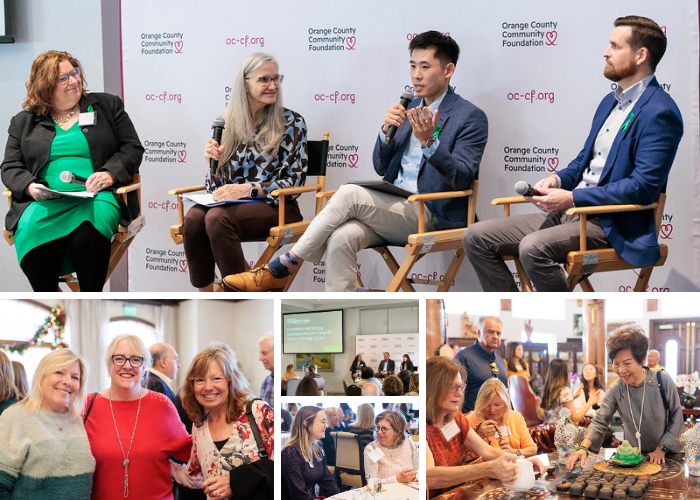
The Orange County Community Foundation’s Family Foundation Alliance recently kicked off its 2026 programming with a learning event focused on one of the most urgent and overlooked issues in philanthropy: the needs of older adults.
Only two percent of philanthropic funding nationwide supports older adults, yet more than 10,000 Americans turn 65 every day, a demographic shift driven by the aging baby boomer generation, according to the U.S. Census Bureau.

This shift will accelerate dramatically over the next two decades. In Orange County, the numbers are especially striking. Today, more than 550,000 of the county’s 3.2 million residents are age 65 or older (according to Neilsberg Research), and it is the only age group projected to grow rapidly in the coming years.
The program featured keynote speaker Lisa Wright Jenkins, president and CEO of the Council on Aging Southern California, followed by a panel of Family Foundation Alliance members sharing their experiences in funding this space, what they have learned, how their giving has evolved, and recommendations for other funders looking to make an impact.
A Population Shift Already Underway
Keri Mesina, senior director of OCCF’s Center for Engaged Philanthropy, opened the program by framing the scale of the challenge.
“We’re in the midst of a population shift,” she said. “People are living longer, families are more geographically spread out, and the systems that once supported aging are under strain. At the same time, older adults want the same things we all do — to remain healthy, connected, safe, and able to live with dignity in the communities we call home.”
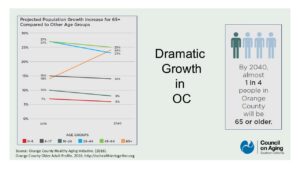 Jenkins grounded the conversation in data about what aging looks like across Orange County. With more than half a million older adults already living in the county and the population continuing to grow, she emphasized that communities are not yet fully prepared for the scale of change ahead.
“By 2040, one in four people in Orange County will be over the age of 65,” Jenkins said. “That means they will join us in our neighborhoods, in our hospitals, on our freeways, and in our communities. This demographic shift will fundamentally change how our community operates.”
She also highlighted the realities many older adults face today, including social isolation, housing instability, food insecurity, limited access to healthcare, and the rising cost of care. In-home caregiving in Orange County now averages $35 per hour, a cost that can quickly become unsustainable for many families.
The Importance of Planning for Aging
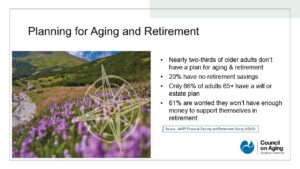 Jenkins described the Council on Aging’s role as a navigation hub for older adults and caregivers through programs such as Medicare counseling through HICAP, the long-term care ombudsman program, and community-based efforts to combat isolation. She emphasized the importance of planning early rather than waiting until families face a crisis.
“What we find is that most people contact us during a crisis — after a hospitalization or diagnosis,” Jenkins said. “That’s not the time to plan. The time to plan is before that happens.”
To help older adults prepare earlier, the Council on Aging developed a practical planning guide called “Aging My Way.” The handbook walks individuals through key decisions that shape later years of life, including healthcare planning, housing options, transportation, finances, lifelong learning, volunteering, and caregiving needs. By encouraging thoughtful planning before a crisis occurs, the guide empowers older adults to thrive and remain independent longer while easing the burden on caregivers and community systems as they age.
Philanthropy in Action
A panel of family foundation leaders brought the data to life by sharing how their philanthropy has evolved in response to the needs of older adults.
Joanna Kong, executive director of the Sun Family Foundation, shared that her commitment to this work is deeply personal. Much of it stems from her relationship with her grandmother and from a Chinese cultural value known as Xiao, a Confucian virtue that emphasizes respect, care, and responsibility toward elders.
“In our culture, Xiao reflects a moral and ethical obligation to care for our elders,” Kong said. “Older adults are the keepers of history and wisdom in our communities.”
This value now shapes the Sun Foundation’s philanthropic priorities, with a focus not only on services for older adults but also on ensuring they are treated with dignity and respect.
Harriet Harris, co-founder of the Brethren Community Foundation, spoke candidly about the growing caregiving crisis and the urgent need to build a stronger workforce to support our aging population. After navigating Alzheimer’s care in her own family, she has become a strong advocate for investing in caregiver training and workforce development.
“The need for caregiving is huge,” Harris said. “And we simply do not have enough caregivers to meet the needs of our growing population.”

Her experience highlighted a reality many families face: caring for aging loved ones often requires multiple caregivers and significant financial resources. Expanding the caregiving workforce, she noted, will be essential to meet the demand ahead.
Jeffrey Smith, executive director of the George Hoag Family Foundation, described how his foundation’s work with vulnerable populations has increasingly focused on senior homelessness, now the fastest growing segment of the unhoused population in Orange County.
“It’s far more cost effective to keep someone housed than to help them recover after they’ve fallen into homelessness,” Smith said, pointing to programs that focus on prevention through eviction assistance and financial stabilization.
Panelists also highlighted innovative models that address multiple needs at once. Smith pointed to Meals on Wheels not only as a food delivery service but also as a critical point of human connection for isolated seniors. Others discussed intergenerational approaches, including programs that pair nursing students with older adults in care facilities and community designs that intentionally connect seniors with younger generations.
A New Lens for Philanthropy
One of the most powerful takeaways from the afternoon came during the discussion about how philanthropy can move from learning to action.
Kong encouraged funders to rethink how they approach the issue: “Think about older adults not as a separate funding category, but as a lens,” she said. “Every issue we fund — housing, food insecurity, healthcare, arts, mental health — intersects with the needs of older adults. The question we should be asking is how older adults are included in the work we already support.”
From Awareness to Action
While the realities of our older adult population can feel daunting, the tone of the afternoon was hopeful and solutions-focused. Funders left with a renewed sense of urgency and possibility, recognizing that philanthropy has a meaningful role to play in responding to one of the most significant demographic shifts of our time.
Ensuring that older adults in Orange County can age with dignity, connection, and purpose will require collaboration, innovation, and a broader philanthropic commitment. The conversation made clear that the time to begin is now.