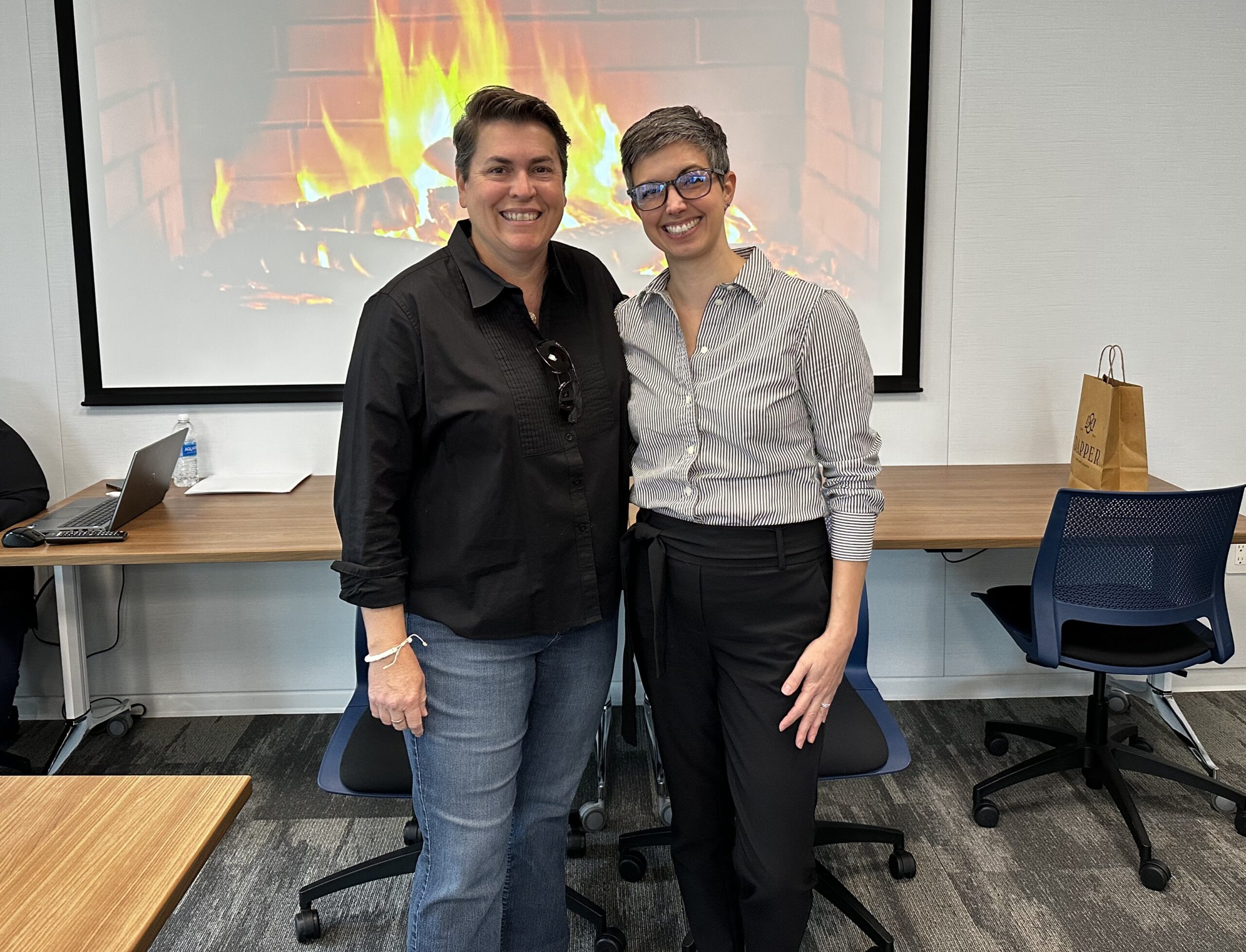
Recently, Peg Corley, the CEO of the LGBTQ Center Orange County, connected with our team to deepen our understanding of their impactful work and the needs of the LGBTQ+ communities we serve. Founded in 1975, the LGBTQ Center OC is dedicated to advocating for the rights and well-being of the Orange County Lesbian, Gay, Bisexual, Transgender, and Queer/Questioning communities, ensuring they thrive with positive identity and support.
Anastasia Rowland: How did you get involved with the LGBTQ Center OC?
Peg Corley: I started in 1998 as a board member, and I was on the board at The Center for 12 years. During that time, I was also a financial planner for Morgan Stanley. I helped a lot of people, but it wasn’t fulfilling me in the way that I felt when I was the board chair of the Center. And just about that that time, wouldn’t you know they were looking for a new CEO. I threw my hat in the ring and they scooped me up and I’ve never looked back. And so that was nine years ago that I came on board in this capacity.
Anastasia Rowland: Can you tell us how the organization started and how it’s evolved over the years?
Peg Corley: We were founded in 1971, literally out of a garage in Garden Grove, and it started as a hotline for folks that needed help. In the mid 70s, there came the HIV crisis. And so we started building out programs to assist HIV-infected and affected individuals with prevention, testing, linkage to care, but also food delivery, transportation to appointments, and legal services like helping them with wills and trusts. So that started our Health and Human services growth, which through the years expanded into pretty much everywhere you see LGBTQ people struggling. So think about the most vulnerable people, certainly the immigrant community, and youth, the aged community, folks with different abilities, trans folks. So we started really filling gaps where we saw our communities struggling the most. And now today it means we’re a little bit everywhere and lifting up folks that need a little bit of extra support.
Anastasia Rowland: Let’s talk about mental health and wellbeing—specifically youth mental health and the work the LGBTQ Center is doing with schools and families.
Peg Corley: OK. So you know growing up is not easy, right? No matter who you are or where you come from, or what your family looks like, we all have our challenges growing up. And for LGBTQ kids, a lot of them are growing up in families that are not necessarily affirming. And maybe they will become more affirming with some information and some understanding but still they start out not affirming because that’s not who they think their kids are. There’s a lot of struggle for our young people, especially if you toss in the nuances of identity. And so we provide support, in addition to being open for youth to come in, by serving in over 50 middle and high schools throughout Orange County. We partner with members of staff, administration, faculty, or a counselor, and we’re invited to come in to help form or support the youth affinity group on campus. We help them understand, you know, LGBTQ history, the timeline of our movement, and of our people, how they can see themselves in history or in literature, how they can incorporate that on their school campuses, how to speak to administrators, their peers, how to talk to their parents. We’re also teaching “Know Your Rights” seminars and workshops where we invite parents and administrators and we do faculty trainings.
Anastasia Rowland: It’s really important, even if the family you were born into isn’t supportive, that there can be chosen family and others that can help you.
Peg Corley: We had a non-binary young person that came to a youth group meeting. They were 17 and weren’t out at home or at school. They found our safe space. They wanted to come just be with people who are like them. And they took a bus for an hour and a half to get there and an hour and a half to get back home. Just to be in a safe space.
Anastasia Rowland: Safe spaces are so important. Allyship is so important. You’ve spoken beautifully on what allyship really looks like, and the difference between an ally and a bystander. Can you talk about that a little bit?
Peg Corley: Yeah, this is my absolute favorite topic. I’m talking about LGBTQ allyship at the moment but use your imagination and insert any marginalized community into the same conversation because it works for us all. Here’s the deal: If you have love in your heart and you wouldn’t do anything to hurt anyone in a particular community, you would never say something disparaging and you wish them really well. That’s not being an ally. That’s a bystander. We love you and thank you for the well wishes and positive energy, but being an ally is an action word. It’s like a superhero. Think about it, right, like— in fact, Shelley gave me this idea. I gave a speech about it once, the letter “A” with a cape. That’s a powerful action word and so what that really means is you’ve got to be doing something. And there’s an opportunity just about every day that comes your way. And what you choose to do in that moment is going to define whether or not you’re an ally and how you know how strong of an ally you are.
Anastasia Rowland: We talked about pronouns not being performative. That’s a really easy thing that people could do.
Peg Corley: Let me just tell you how it is for people like me when I see those pronouns on your e-mail signature. Your name and then “she/her,” if that’s what you choose to use. It says so much more than how you identify. It tells me that you’re cool with me telling you how I identify. And I know now that you’re not assuming that you know how I identify based on how I’m presenting. Easiest, easiest, easiest active allyship you can do. And if you’re someone that walks through the world very much in alignment with how you express your gender and how you identify with your gender, then by putting your pronouns under your name you’re not telling people how you identify (because you already have), but you’re opening the door for everybody else.
Anastasia Rowland: Creating in itself a welcoming, safe space.
Peg Corley: Yeah. You’re normalizing this thing—that it’s okay to talk about how we identify in this space.
Anastasia Rowland: To have the conversation.
Peg Corley: Yeah.
Anastasia Rowland: We talked about gendered language too. Just even when we start an event and we start out saying, “ladies and gentlemen,” we’ve just isolated a section of the room.
Peg Corley: I’ve had to say, “friends and family,” or I’ve had to say, “ladies and gentlemen, all those in between and beyond.” I mean, you can use your imagination, but yeah, “ladies and gentlemen” actually does alienate a few people in the room.
Anastasia Rowland: It’s isolating. It others you in a way, especially for an organization like ours that is very much a convener of community and we want to be welcoming of everyone. That’s what having these conversations does. It makes you take that extra second to think about how you show up.
Peg Corley: I’m dying to know what [the team] is thinking.
Anastasia Rowland: Yeah, let’s open up to questions.
OCCF Staff: I see you all over the place in Orange County, we cross paths in lots of spaces. Where do you see your organization creating partnerships across the region?
Peg Corley: So that’s one thing about this organization, we’re such an organic partner. It’s pretty amazing, so we don’t say no. If anyone out there, even a for-profit company wants to do a better job of creating a safe space for LGBTQ people, we’re going to say, “Heck yes, I will help you out! Let us work together,” and we’ll show you how to create documents that are non-gendered or help with policies and things like that.
OCCF Staff: With everything you’re doing, how big is your organization?
Peg Corley: Not nearly as big as you think it might be. We have about 22 staff.
Anastasia Rowland: What are some of the services you provide?
Peg Corley: We have Health & Human Services. We have mental health counseling on a sliding scale seven days a week in two or three different languages. No one has ever been turned away because they can’t afford to pay for counseling. We conduct about 7,000 counseling sessions a year—the mental health counseling youth program in the schools—and at the Center we serve about 4,000 youth a year. We serve 1,200 individuals a year, helping them change their legal name and/or gender marker on documents like their driver’s license, passport, all that stuff. We also have trans orientation, where parents can come learn about what that’s like. If my child wants to transition, at what point do I get a counselor? Does my child get a counselor? Do we talk to the same counselor at the same time? Like there’s a lot of questions around that and we just help folks understand what that looks like. We also do Health & Wellness, including smoking cessation and HIV testing/prevention.
OCCF Staff: When you talk about going into the schools, do you get access to the students, teach the teachers, or is it for the parents?
Peg Corley: Sure, it’s all the above. There are obviously queer kids at every school and a lot of the counselors understand that they need a little bit more support and want to make sure their campus is affirming. So we’re invited to come in, meet with advisors, teachers, administrators, counselors—whomever is attached to the support network for a student or group of students—and try to understand the needs, the directives. You know, does your groups of kids meet monthly? Are they allowed to meet? What does it look like at this school? And then we start implementing support services, generally with a staff advisor hosting a place for kids to meet, either at lunchtime or before or after school. And they’ll talk about current events. What was it like for you at home this week? It’s a peer group.
At the beginning of the year, schools will have a Welcome Back Fair and very frequently they want the LGBTQ Center to have a table there. So kids have the ability to come up and ask questions and then parents, or the counselor will refer parents to contact us. We try to interface. You know, when our kids have parents behind them, they do better. They do way, way better. It’s never our goal to go around the parents. We want to include the parents because that is so much more support for our young people.
OCCF Staff: You probably run into things that are difficult to see. Is there support for your own staff?
Peg Corley: Not enough. My staff are on the front lines and there is no pretty way to describe what that looks like. And there are times when we have to leave outreach events because we’re being threatened or yelled at. But you know we have, certainly we have benefits. We have a mental health care hotline through our insurance, we have a counseling department. But beyond that, there’s the ability to work from home as you need to and quarterly retreat days. It’s an evolving question.
Anastasia Rowland: Having leaders that are really in tune with their people is super important. The work we’re doing, it’s personal right? That’s why we do this. That’s why we’re here. We choose to work here because we want to make a difference in our communities. We want to give back. We want to be part of making things better.
Peg Corley: Shelley taught me years ago, in a very Shelley way: All philanthropy in Orange County is good philanthropy, whether they’re giving to my organization or not. If they’re giving to anyone in Orange County, I’m grateful because there’s a lot of spaces in Orange County that need this support.