What if changing when you give—not how much—could significantly increase the tax benefits of your charitable giving?
Changes to the tax landscape have made that question increasingly relevant for charitably-minded families.

The higher standard deduction established under the Tax Cuts and Jobs Act (TCJA), combined with more recent changes under the 2025 OBBBA, has raised the threshold for realizing the tax benefits of itemized charitable deductions. For donors who give consistently year after year, this creates an opportunity to rethink not only how much they give, but when. One increasingly valuable strategy is “bunching” – combining several years of charitable contributions into a single tax year, often through a donor-advised fund (DAF). Done thoughtfully, bunching can help donors maximize deductions while maintaining consistent support for the causes they care about most—and can provide a natural framework for engaging family members in an intentional, multigenerational approach to giving. Community foundations like the Orange County Community Foundation offer invaluable expertise and guidance in navigating these approaches, ensuring both immediate tax benefits and long-term philanthropic impact.
The Itemization Challenge and the Bunching Solution
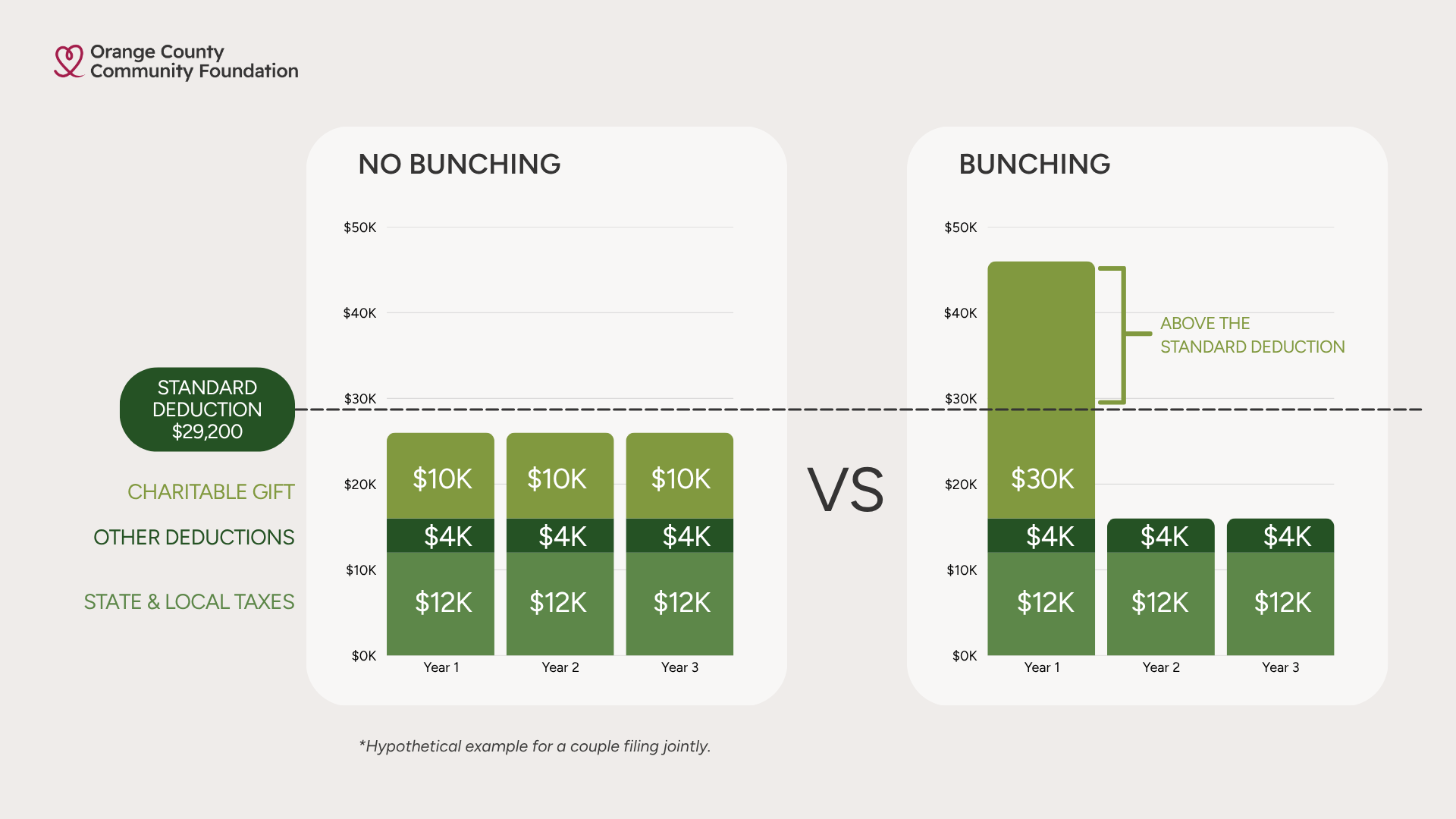
Prior to the tax overhaul, many households easily surpassed the itemization threshold through a combination of state and local taxes, mortgage interest, and annual charitable gifts. Today, with a much higher standard deduction, routine annual giving often fails to provide any tax benefit because the total itemized deductions fall below the standard threshold. “Bunching” is a financial strategy designed to overcome this barrier. Instead of making moderate charitable contributions every year, a donor concentrates multiple years’ worth of giving into a single calendar year. By consolidating charitable contributions into one year, donors can push their total deductions above the standard deduction threshold, unlocking meaningful tax savings. In subsequent years, the donor claims the standard deduction. Over a multi-year cycle, this alternating pattern can significantly reduce the donor’s overall tax liability compared to a set annual giving amount.
Donor-Advised Funds: A Flexible Solution
Bunching is financially sound, but donating a large sum at once can have unintended consequences for nonprofits. Most nonprofits rely on steady, recurring cash flows to operate; a one-time influx of cash followed by several years of absence can create challenges for their operational budgeting. Furthermore, donors may not know which organizations they want to support in the following years. This is where a Donor-Advised Fund (DAF) serves as the perfect vehicle. A DAF is a charitable fund administered by a public charity– originally created by community foundations but now offered by a wide variety of entities– with charitable grants made with guidance from the donor. When a donor bunches multiple years of contributions into a DAF, they receive an immediate tax deduction for the full amount in that tax year, while the donor chooses the timing and focus of their granting over time. The funds are invested, growing tax-free for the benefit of nonprofit beneficiaries, while the donor retains advisory privileges to grant those funds out in the ensuing years. For example, a donor can bunch a $50,000 contribution into a DAF in a high-income year, claim the deduction immediately to offset a peak tax bracket, and then thoughtfully and strategically grant funds out to maximize their charitable impact on the causes closest to their heart.
While all DAF providers provide the same tax benefits, community foundations like OCCF offer a unique range of personalized philanthropic services customized to each donor’s needs. Our knowledgeable staff brings expertise not only on community needs and the local nonprofit sector, but on best practices on individual and family philanthropy and the ability to support grantmaking locally, across the country and around the world.
Maximizing Tax Efficiency with Appreciated Assets
The tax utility of a DAF extends far beyond cash contributions. The most efficient way to fund a DAF during a bunching year is by donating long-term appreciated assets, such as publicly traded stocks, real estate, or other complex assets. When a donor contributes appreciated assets held for more than one year directly to a DAF, they receive a double tax benefit. First, they can deduct the entire fair market value of the asset (within current AGI limits). Second, they can avoid paying capital gains tax on the asset’s appreciation. The DAF provider, a community foundation or other 501(c)(3) public charity, will normally liquidate the asset and convert tax-free to cash immediately, ensuring that 100% of the asset’s value goes toward philanthropic purposes uneroded by taxes. Community foundations are especially adept at handling these types of complex contributions and their expertise ensures donors fully leverage the benefits of appreciated asset contributions, enhancing the overall impact of their charitable giving.
Promoting a Generational Legacy of Giving
Beyond the immediate financial and tax advantages, the combination of bunching and DAFs provides an ideal framework for intergenerational family giving. When support by a community foundation like OCCF, a donor-advised fund can be a real-world educational tool for younger generations to learn about financial stewardship, wealth management, and social responsibility together with their families. Unlike direct donations, a donor-advised fund creates a structured, ongoing family giving practice. Parents and grandparents can establish a family fund and invite children or grandchildren to act as co-advisors or fund successors. With OCCF’s support, families can institute regular meetings to review the performance of the fund’s investments and collectively discuss which grants to make. This collaborative environment encourages younger family members to research causes, evaluate nonprofit effectiveness, and convey their personal values. Donor-advised funds at community foundations can be lasting vehicles built for succession. Since the assets within the fund grow tax-free, a well-invested fund bunched during a wealth-creator’s peak earning years can transform into an enduring endowment that funds family grants for years to come.
To learn about bunching or discuss potential gifting of complex illiquid asses, please contact Brian Schaefgen, Chief Financial Officer.